National University of Political Studies and Public Administration
Archives
-
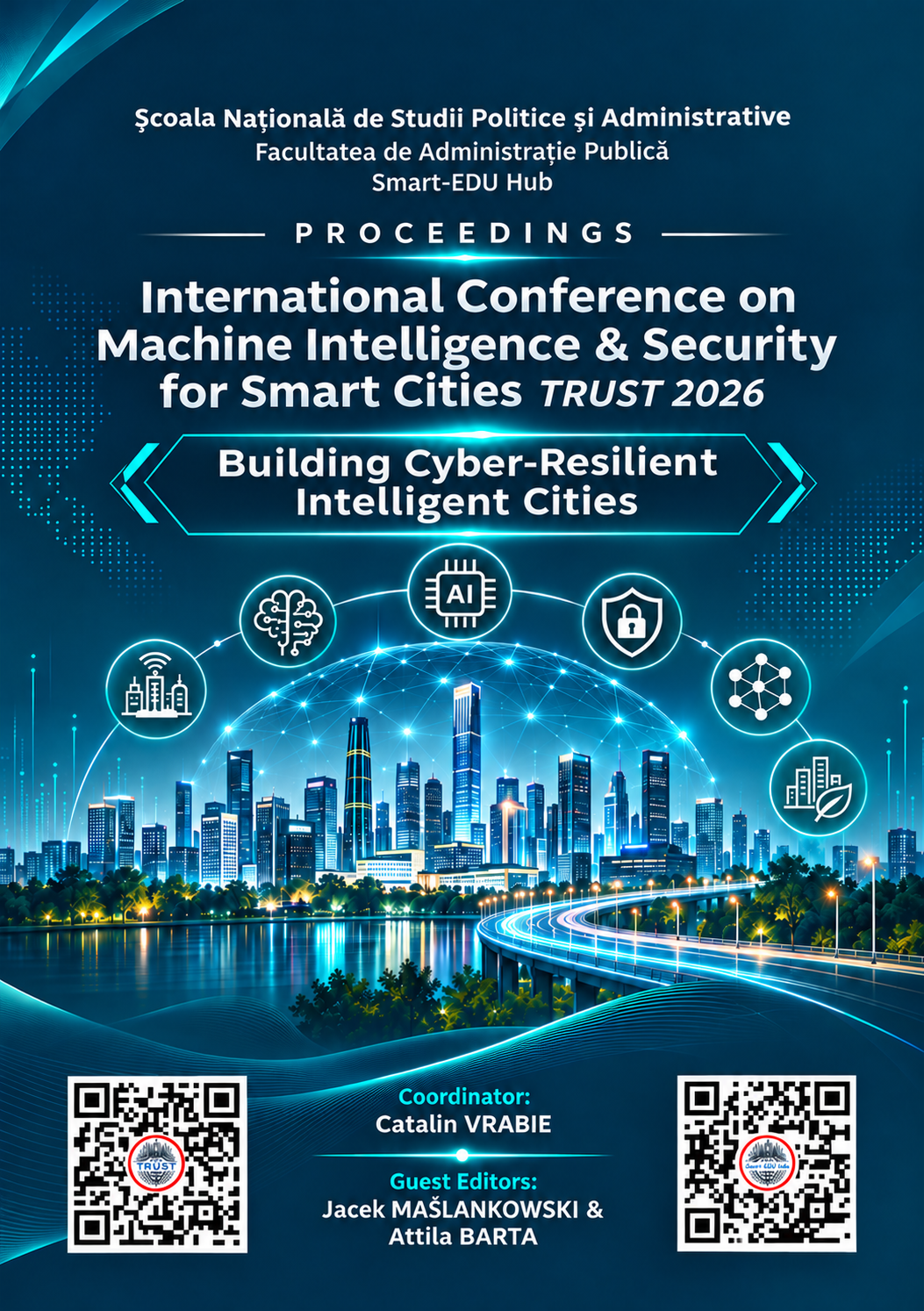
Building Cyber-Resilient Intelligent Cities
Vol. 3 (2026)Proceedings of the 7th International Conference on Machine Intelligence & Security for Smart Cities (TRUST) – June 2026
Guest Editors:
Jacek MAŚLANKOWSKI, University of Gdańsk, Poland
Attila BARTA, University of Debrecen, HungaryThe seventh edition of the International Conference on Machine Intelligence & Security for Smart Cities (TRUST 2026), organized in Bucharest on 15–16 June 2026 under the theme “Building Cyber-Resilient Intelligent Cities,” brought together an interdisciplinary community concerned with the opportunities and risks created by artificial intelligence, connected infrastructures, data-intensive governance, and rapidly evolving cyber threats. This editorial introduces the intellectual architecture of the proceedings and situates the included contributions within five mutually reinforcing domains: AI-enabled cybersecurity and critical-infrastructure resilience; trustworthy, explainable, and socially legitimate AI; secure interoperability and data governance; intelligent public services and sectoral applications; and human, institutional, and educational capacity. Taken together, the papers demonstrate that cyber-resilience cannot be reduced to defensive technology. It is a governance capability that must combine technical robustness, institutional accountability, human oversight, legal compliance, social inclusion, and the capacity to recover and learn. The volume therefore reflects the central premise of TRUST: intelligent cities become sustainable only when trust is deliberately designed, continuously tested, and institutionally defended.
-

Ensuring Trust and Security in Intelligent Urban Ecosystems
Vol. 2 (2025)Proceedings of the 6th International Conference on Machine Intelligence & Security for Smart Cities (TRUST) - June 2025
Pro Universitaria Publishing House - ISBN: 978-606-26-2227-5The proceedings of the 6th Edition of Machine Intelligence & Security for Smart Cities (TRUST) bring together interdisciplinary research at the intersection of artificial intelligence, cybersecurity, and public sector innovation, with a specific focus on intelligent urban and regional ecosystems. The contributions span applied AI for public administration and critical services - image analysis to improve municipal response capacity, real-time monitoring and predictive maintenance in sustainable aquaculture, smart supply chains for hospital construction, facial detection for border security, and lecturer face recognition in smart classrooms. Cybersecurity is addressed from multiple angles: OWASP API security risks and API gateway patterns, AI as both guardian and threat in cyber defence, social engineering and phishing from a semiotic lens, AI-assisted disinformation, and practical uses of AI for cybersecurity triage. Several papers tackle regulatory and governance challenges, including EU regulatory compliance and digitalization of public administration, data protection in the era of AI, architecture frameworks for secure management platforms, integrated command-and-control centers, and government-as-a-platform approaches in university management. Finally, the volume highlights broader socio-economic and ethical dimensions, such as energy poverty and AI, fake news about 5G in smart cities, ethical issues in healthcare management, algorithmic governance of human resources, and strategies for green and digital rural resilience. Together, these studies offer a nuanced view of how trust and security can be ensured in increasingly data-driven, AI-enabled societies.
-
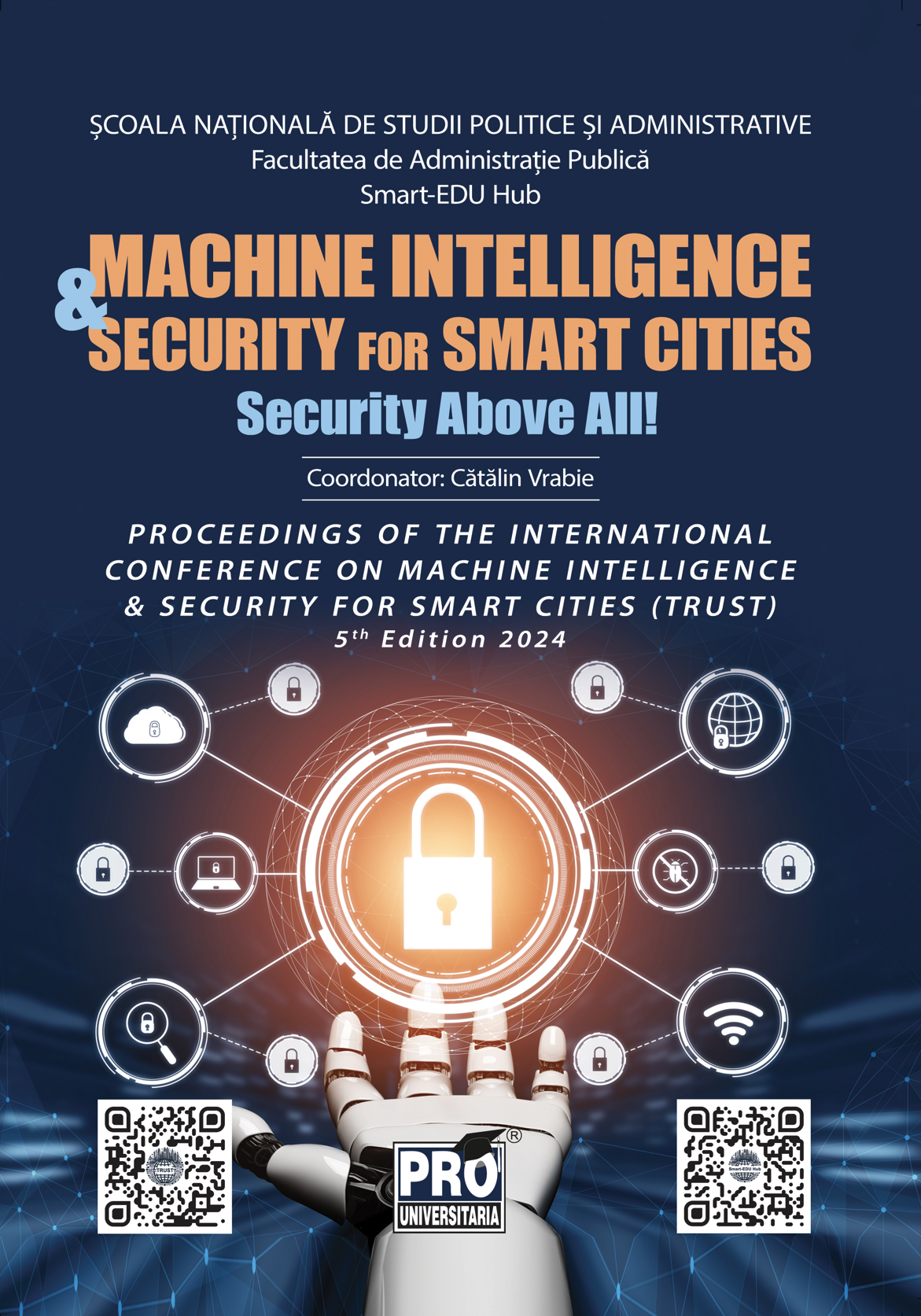
Security Above All!
Vol. 1 (2024)Proceedings of the 5th International Conference on Machine Intelligence & Security for Smart Cities (TRUST) - June 2024
Pro Universitaria Publishing House - ISBN: 978-606-26-1946-6The International Conference on Machine Intelligence & Security for Smart Cities (TRUST) 2024, (previously Securing Smart Cities International Conference - SCIC) highlighted key advancements in ICT security and the integration of AI in enhancing security measures. The event addressed critical issues such as ICT Security Solutions in European enterprises, the relationship between AI and cybersecurity, and the future trajectory of this dynamic. Discussions included practical implementations of ICT security and the profound impacts of AI on cybersecurity. The conference also focused on inclusivity and the role of education in combating misinformation. Topics covered included the need for accessible environments for people with disabilities, strategies to empower individuals with critical thinking skills to fight fake news, and the broader implications of cybersecurity breaches on international political landscapes. Studies on cybercrime's impact on data security and various hypothetical and real scenarios of attacks against smart cities were also featured, providing comprehensive insights into the evolving landscape of smart city security.